

Seeking the Artistry in Research
Research as Art Competition 2027
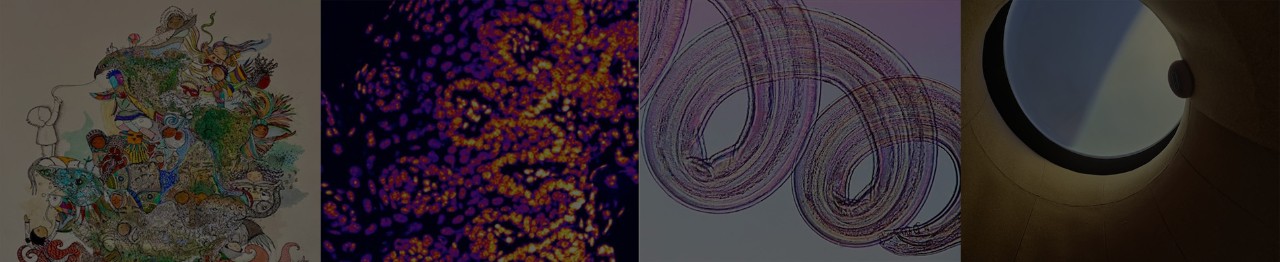
Last year's Research as Art competition was a wonderful success, with our highest number of submissions to date! Contestants showcased their research through stunning imagery, with representation from disciplines including neuroscience, textile design, microbiology, occupational therapy and architecture.
Jefferson students, faculty, postdocs, and staff members involved with research or scholarly work are encouraged to submit their work for the Research as Art Competition 2027!
The competition will be open from September 30th to November 2nd, 2026. Click the button below to learn more about the competition and to submit your entry.
Research Art Competition 2026
Jefferson’s 2026 Research as Art Competition celebrates all Jefferson faculty, students and staff who have an eye for the beauty in their research or scholarship. Our panel of judges selected a winner from two categories: life under the microscope, reflecting cellular and molecular work; and conceptual art that shows renderings of research observations, experiences and concepts in various media. They judged each piece based on aesthetic quality, meaning and originality.
This year, we had 44 submissions with representation from disciplines including neuroscience, textile design, microbiology, occupational therapy and architecture. Each work depicts the creative aspects of academic study that often go underappreciated. The images also do something that is rare in research: they invite the novice or uninitiated to interact with the topic, to bring their own experiences to bear in the interpretation and to appreciate research as art. We hope you will enjoy this year’s images.


Conceptual Art Winner Pamela Talero Cabrejo
"Without Borders"
This artwork, created for the cover of Occupational Therapy Without Borders, configures the world map without borders, dissolving it into a vibrant background of people, animals and landscapes. The continents become inseparable from the living mosaic of creatures, symbolizing how human and ecological life are intertwined. Figures move together in rhythm, representing the shared struggles and hopes that connect humankind. The composition reflects both beauty and defiance — communities orchestrating resilience while interrogating injustice. From a research perspective, the image shows how occupational therapy engages with diversity, equity and belonging, where knowledge emerges through collective action, creativity and interconnected perspectives.


Life Under the Microscope Winner Elham Javed
"Taste Buds on Fire"
This image reveals the intricate world of mouse taste buds, glowing fiery hues that capture the energy of sensation itself. The tongue tissue was stained with DAPI, a nuclear dye used to identify each cluster of taste bud cells — gateways where chemicals from food ignite electrical signals that travel to the brain to create the perception of taste. The depth of the tissue is color-coded in the hues of fire, adding dimension to the image. Beneath the microscope, what appears as flames is, in fact, the beauty of biology — where flavor begins and the science of sensation comes to life.
See the Work
Starting February 10th, a selection of the art will be on display at Scott Memorial Library, on the second floor, until March 16th. We hope you'll stop by the exhibit!
2026 Research Art Competition Submissions
Browse a selection of additional entries below, and explore all of the submissions via downloadable PDF that includes images and descriptions from the artists.
Sorry, no results found.
This Year's Judges
-

Renee Walker
Renée Walker is an Associate Professor of Visual Communication Design at Thomas Jefferson University, exploring design, data and natural world intersections. She specializes in multi-sensory data visualization, making complex information accessible through visual and interactive experiences. Her work includes Energy Bodies — featured at Info+ 2025 at MIT — and research translating bird songs into animated visual forms. Walker collaborates across design, public health and urban environments, recently contributing to the Jefferson Intersections exhibit at the Venice Architecture Biennale.
-

JoAnna Wendel
JoAnna Wendel is a science writer and artist living in Portland, OR. She currently works as a public information officer at the Pacific Northwest National Laboratory, where she writes about everything energy-related, from batteries to manufacturing to electrical grid science. She is also a professional cartoonist who illustrates the Wild Things comics series for Science News Explores. In her spare time, JoAnna reads, draws, paints, and when it's not raining, spends as much time as possible in the woods.